- Level 3
- 12 Hours Duration (2 Days)
- 3 Year Certificate
- Train The Trainer
- 8 Delegates
- Includes Practical
Anaphylaxis Train the Trainer Course
This course prepares staff to confidently deliver anaphylaxis training, covering recognition, emergency response, auto-injector use, legal duties, and inclusive teaching strategies across healthcare, education, and care settings.
Gain the required skills
This course equips trainers with the knowledge and skills to teach anaphylaxis awareness and emergency response. Participants will learn about causes, symptoms, and triggers, as well as CPR, recovery position, and risk assessment.
The course covers creating a safe learning environment, managing challenging behaviour, adapting to diverse learning styles, legal and regulatory requirements, and developing training resources, culminating in a micro-teaching emergency response demonstration.
Course Summary
- Know Your Roles and Responsibilities as a Trainer.
- Comprehending Anaphylaxis: Understanding its causes, symptoms, and common triggers.
- Emergency Response and Risk Assessment: Reviewing key techniques, including primary surveys, CPR, and the recovery position.
- Creating a Safe and Inclusive Learning Environment: Ensuring training is accessible and supportive for all participants.
- Effective Communication and Feedback: Delivering clear instructions and constructive feedback.
- Adapting Training for Diverse Learning Styles: Tailoring methods to meet individual needs.
- Managing Challenging Behaviour: Strategies for maintaining focus and engagement during sessions.
- Assessing Learner Competence: Evaluating knowledge and practical skills in anaphylaxis response.
- Developing Training Materials and Resources: Creating effective educational tools for anaphylaxis courses.
- Legal and Regulatory Knowledge: Understanding relevant legislation and guidelines, including Natasha’s Law and Resuscitation Council UK standards.
- Micro-Teaching Practice: Conducting a 15-minute anaphylaxis emergency response demonstration followed by peer evaluation.
Tell us how we can help
Tell us what you need and we will find the best solution for you fast - getting back to you within one working day - (usually the same day)
Available Booking Slots For Individuals
We Can Help You Through Your Booking
FAQs
Do I need to have prior knowledge before attending this course?
Yes you do. You need to have prior knowledge and competence within the subject. This course is to teach you to deliver your own course on the subject, not to teach you the subject itself.
Will I have to conduct a microteach?
Yes, you will be required to conduct a minimum 15 minute microteach during the course to the rest of the class.
Can I purchase the presentations and materials to use in my own courses?
Yes you can, Just ask a member of staff and they can run you through the whole process!
Where Do You Deliver Training?
We can deliver this Train the Trainer course at your premises, as long as it's within the UK. Also, we have our own venues in the Midlands if you don't have access to a training room. In addition, we are able to run this as a blended course (1 Day face to face and 1 day Virtual).
How Do You Deliver The Training?
We will deliver the Anaphylaxis awareness train the trainer at your premises for a group of up to 8 delegates. In addition, we offer open courses for individuals which can be booked below if available.
Who Can I Teach After Attending This Course?
Please note you can only teach “inhouse” staff. If you wish to train delegates outside of your organisation you will need a Level 3 Award in Education and Training or a teaching qualification.
How Many delegates can I have on one session?
We will run this course for a maximum of 8 delegates – however for larger groups we can either provide multiple trainers on the same day or run multiple days to get everyone trained.
Who Will Conduct The Training?
One of our expert tutors who have an abundance of training and assessing experience and knowledge – so you’ll be in great hands! Furthermore, we will let you know who is doing the training in advance, you can check out their skills and experience by finding them on our meet the team page.
Anaphylaxis Train the Trainer Course
Anaphylaxis Train the Trainer course equips experienced staff with the knowledge and confidence to deliver high-quality anaphylaxis training within their organisation.
Participants will gain a deep understanding of anaphylaxis triggers, recognition, emergency response, and the use of adrenaline auto-injectors (e.g., EpiPen, Jext).
The course also covers legal responsibilities, risk assessment, and how to tailor training for different audiences, including schools, care settings, and healthcare teams.
Practical teaching strategies, scenario planning, and assessment techniques are included to support effective delivery. Ideal for clinical leads, first aid trainers, and safeguarding champions responsible for cascading life-saving knowledge across teams.
Course Outline
Anaphylaxis Instructor Training – Course Outline
- Know Your Roles and Responsibilities as a Trainer
Clarify your duty to deliver accurate, life-saving content, build learner confidence, and uphold clinical standards. - Comprehending Anaphylaxis
Understand what anaphylaxis is, identify common triggers, and recognise early and late-phase symptoms across age groups. - Emergency Response and Risk Assessment
Review DRABC, CPR, recovery position, and adrenaline auto-injector use. Explore risk assessment in schools, care homes, and clinical settings. - Creating a Safe and Inclusive Learning Environment
Ensure training is emotionally safe, accessible, and responsive to learners’ needs, including neurodiversity and trauma-informed practice. - Effective Communication and Feedback
Deliver clear instructions and offer constructive feedback to support learner understanding and confidence. - Adapting Training for Diverse Learning Styles
Use demonstrations, case studies, role-play, and visual aids to engage learners across health, education, and care sectors. - Managing Challenging Behaviour
Apply strategies to maintain focus and engagement, especially when discussing high-risk or emotionally charged scenarios. - Assessing Learner Competence
Design and deliver assessments that evaluate knowledge, practical skills, and confidence in emergency response. - Developing Training Materials and Resources
Create engaging, compliant resources tailored to your audience—whether for induction, refresher training, or emergency drills. - Legal and Regulatory Knowledge
Understand Natasha’s Law, Human Medicines Regulations, Resuscitation Council UK guidance, and your duty of care as a trainer. - Micro-Teaching Practice and Peer Evaluation
Deliver a 15-minute teaching segment on anaphylaxis response, followed by structured peer feedback and reflection.
Our Train the Trainer course provides the knowledge, confidence, and practical teaching skills needed to manage anaphylaxis emergencies and deliver high-quality training to others.
Course Information
Course Information:
- Course Duration: 2 days (12 Hours)
- Course Level: Level 3
- Certificate: 3-year certificate
- Max Delegates: 12
- Practical: Yes ✅
- Course Mode: Face to Face/ Blended
- Prerequisite: Anaphylaxis certificate and industry experience
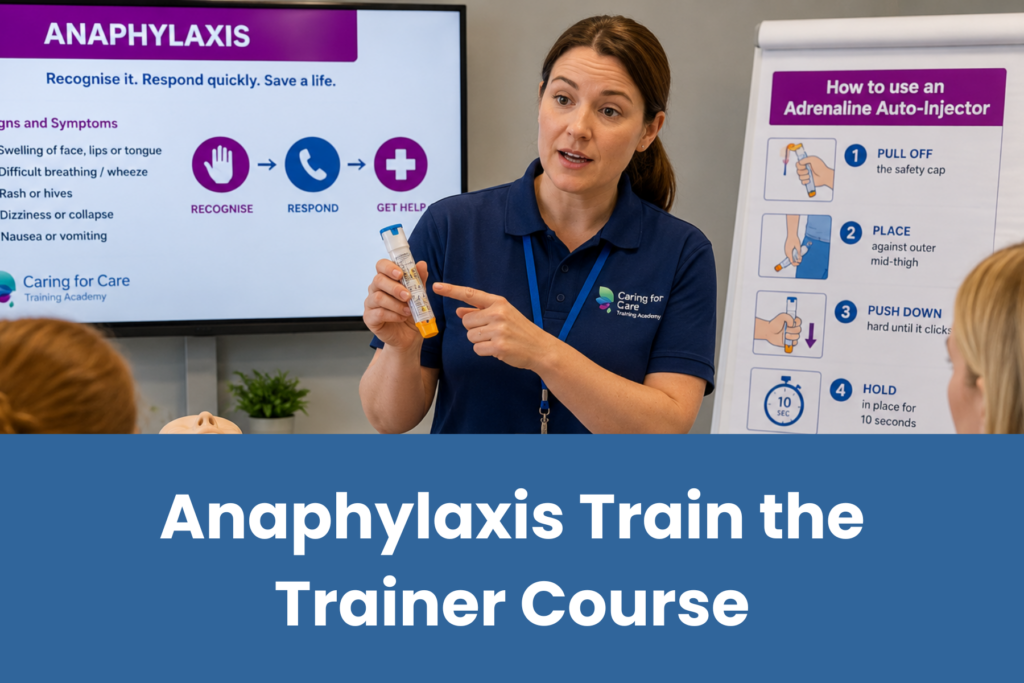
Who is the course for
Who is this course for?
This course is designed for experienced staff who are responsible for delivering anaphylaxis training within their organisation. It is ideal for:
- Clinical leads, first aid trainers, and health and safety officers
- Nurses, paramedics, and healthcare assistants in education, care, or community settings
- School staff, safeguarding leads, and SEND coordinators
- Residential care managers and training coordinators
- Anyone tasked with cascading life-saving knowledge to frontline teams
Participants should already have a solid understanding of anaphylaxis response and be confident in using adrenaline auto-injectors. This course focuses on teaching others, not learning the basics.
Course Benefits
Course Benefits
Benefits to the Individual
- Confidence in teaching life-saving skills to colleagues across care, education, and healthcare settings.
- Enhanced professional credibility with a nationally recognised trainer certificate valid for 3 years.
- Improved communication and teaching techniques, including inclusive delivery and trauma-informed practice.
- Practical strategies for delivering engaging, accessible training to diverse teams.
- Access to ready-to-use resources for efficient and effective course delivery.
Benefits to the Organisation
- Improved emergency preparedness through consistent, high-quality internal training.
- Reduced reliance on external trainers, saving time and cost.
- Stronger compliance with Natasha’s Law, Resuscitation Council UK guidance, and safeguarding frameworks.
- Increased staff confidence and retention, especially in high-risk environments.
- Scalable training delivery across multiple sites, teams, or departments.
Why Book This Course With Us?
Why Book with Caring for Care?
- Nationally recognised and top-rated training provider with over 9,500 positive reviews
- Trusted by 1,000+ organisations across the UK, including NHS Trusts, schools, and care providers
- Over 20,000 individuals trained annually—with consistently high satisfaction and learner outcomes
- 3-year trainer certification for long-term confidence and compliance
- Includes a 15-minute micro-teach with peer and instructor feedback to build real-world teaching confidence
- Delivered by qualified UK instructors with sector-specific expertise
- Access to free learner resource.
- Automatically get 49% discount of essential trainer pack.
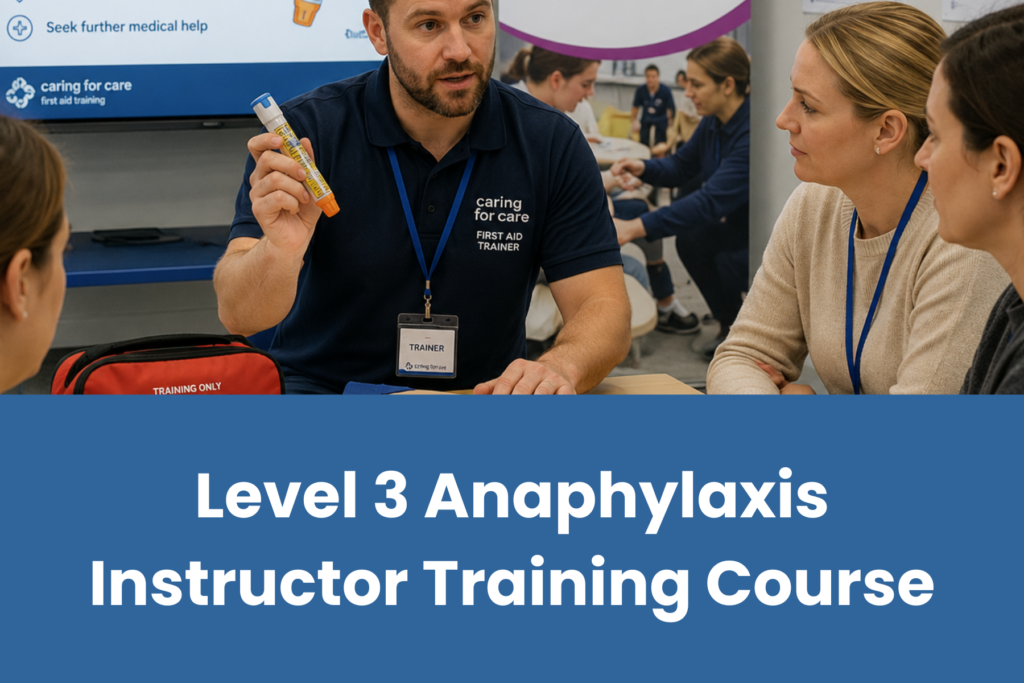
Course FAQs
Anaphylaxis Instructor Training FAQs
1. What Will You Learn as an Anaphylaxis Trainer?
Participants will gain essential instructor skills, including clear communication, effective presentation techniques, and the ability to adapt teaching for diverse learners. They will also learn how to manage challenging behaviour, provide constructive feedback, design engaging training materials, and lead micro-teaching exercises.
These skills enable trainers to share knowledge effectively, build team competence, and strengthen organisational safety culture.
2. What Are the Prerequisites for Participants?
Participants should have prior experience in healthcare, social care, education, or childcare settings where allergy management is relevant. They should also hold a basic understanding of anaphylaxis and allergy response, ideally gained through completion of an introductory awareness course.
Foundational training in areas such as Health & Safety, Food Safety and Hygiene, or Emergency First Aid further demonstrates readiness and ensures participants are well‑prepared to progress to trainer‑level delivery with confidence and compliance
3. Does Caring for Care Offer Onsite Training?
Yes, the course can be delivered onsite at your organisation, which is ideal for teams across healthcare, social care, education, and childcare settings. Onsite training allows organisations to train multiple delegates at once, ensuring consistent delivery, practical application through exercises, and compliance with safety standards.
Organisations also benefit from flexible dates, reduced travel costs, group discounts, teamwide skill development, and content tailored to their specific needs.
4. Can Anyone Teach Anaphylaxis Awareness?
Not everyone is qualified to teach anaphylaxis awareness. Trainers must have relevant experience and complete foundational courses before progressing to the Train the Trainer course to ensure they have the knowledge, instructional skills, and regulatory understanding necessary to deliver credible, safe, and effective training.
They also need confidence in communication, awareness of safeguarding responsibilities, and the ability to adapt content for diverse organisational and learner needs.
5. When Should This Anaphylaxis Instructor Certificate Be Refreshed?
The course should be refreshed every two to three years, or sooner if there are significant updates to legislation, regulatory guidance, or organisational policies. Regular refreshers ensure trainers remain confident in best practice, compliant with current standards, and able to cascade the latest anaphylaxis management strategies.
Certificates are valid for three years and must be renewed upon expiry.
6. Does the Course Cover Adult Teaching Styles and Communication Techniques?
Yes — the Anaphylaxis Train the Trainer course includes modules on adult teaching styles, presentation skills, and effective communication techniques. Trainers learn how to adapt content for diverse audiences, engage learners through interactive methods, and build confidence in delivering sessions.
The training emphasises clear communication, structured delivery, and practical micro‑teaching, ensuring participants can train others credibly, safely, and in line with regulatory standards.
7. Why Is the Course 2 Days and Not 1 Day?
The Train the Trainer course is delivered over two days to ensure participants gain both the subject knowledge and the teaching skills required to deliver credible training. A single day would not allow sufficient time for micro‑teaching practice, peer feedback, and the development of adult learning techniques.
The two‑day format also provides space to cover compliance, safeguarding, and regulatory standards in depth, ensuring trainers leave confident and fully prepared. Please note that only the Trainer Refresher course is completed in one day.
8. Is the Course Delivered Face to Face or Virtual?
Yes — the Anaphylaxis Train the Trainer course is available in both formats. Organisations can choose face‑to‑face delivery, which provides interactive, practical learning with micro‑teaching and immediate feedback, or opt for a virtual format, offering flexibility, reduced travel costs, and accessibility for remote teams.
Both options maintain the same high standards of compliance, safeguarding focus, and trainer skill development, ensuring learners receive credible and effective training