


Diabetes Foot Check Training for Staff Onsite
Health & Social Care Articles | Diabetes Foot Check Training for Staff Onsite
Diabetic Foot Check Training for Staff
Build the knowledge and practical skills needed to carry out diabetic foot checks, recognise common foot problems and identify when further assessment or referral is needed.
Diabetic Foot Check Training is suitable for healthcare professionals and care staff involved in supporting people with diabetes. The course covers the key elements of diabetic foot assessment, including checking sensation, circulation, skin condition, foot shape and other risk factors.
We only offer this course for a team of more than 4 staff. You can visit our eLearning section for individual courses. You can also compare our in-house training on diabetes care and diabetes medication.
📚Related In-House Courses: Diabetes Training | Diabetes Medication Training | Diabetes Train the Trainer
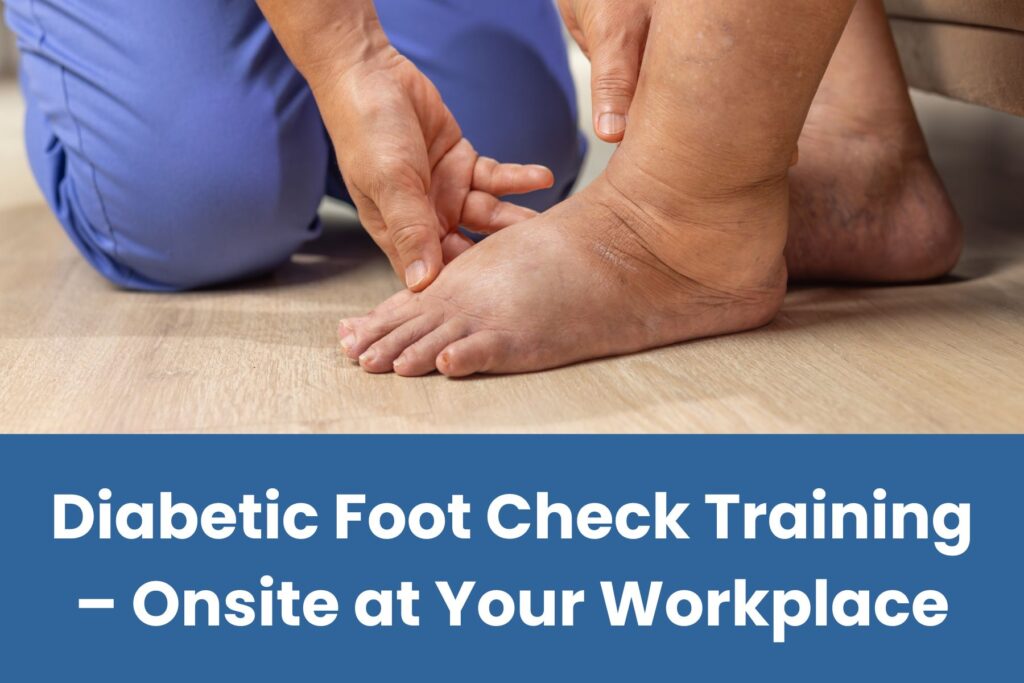
Why Diabetic Foot Checks Matter
Diabetes can increase the risk of foot problems. Nerve damage and reduced blood flow can mean that an injury or change to the foot is not noticed or does not heal properly.
Regular foot checks can help identify problems early.
According to NICE guidance, adults with diabetes should have their risk of developing a diabetic foot problem assessed when diabetes is diagnosed and at least once a year afterwards. Further assessment is also recommended when foot problems develop or when a person is admitted to hospital.
This makes diabetes foot check training an important part of developing safe and effective clinical practice for staff who support people with diabetes.
What Does Our Diabetic Foot Check Training Cover?
This diabetic foot training course covers the key knowledge needed to understand and support diabetic foot assessment.
Session 1: The Basics (30 Mins)
- Why Foot Checks Matter: How diabetes causes nerve damage (loss of feeling) and poor circulation (slow healing).
- The Danger of Ulcers: How a minor blister or scratch can quickly become a serious, hard‑to‑heal wound.
- The Golden Rule: Preventing problems before they start.
Session 2: The “Look & Ask” Routine (50 Mins)
- What to Ask: New pain, numbness, tingling, or fluid leaking into socks.
- What to Look For: Visual check of the top, bottom, heels, and between the toes.
- Spotting Trouble Signs: Dry cracked skin, calluses, thick nails, fungal infections, redness, swelling.
- Footwear Check: Ensuring shoes fit well, don’t rub, and contain no sharp objects or damaged linings.
Session 3: Practical Touch Testing (50 Mins)
- Ipswich Touch Test: Safe fingertip sensation testing while the person’s eyes are closed.
- Safe Foot Care: Washing, drying thoroughly (especially between toes), and correct moisturiser use (never between toes).
Session 4: Red Flags & Reporting (30 Mins)
- Emergency Red Flags: Breaks in the skin (ulcers), hot/swollen/red foot (possible Charcot), black/blue discoloration.
- Who to Tell: How to document findings and who to contact (GP, District Nurse, Podiatrist).
Session 5: More Questions (20 mins)
- Q& A
- Share your experience or ask questions.
Learning Outcomes
By the end of this Diabetes Foot Check Training, learners will be able to:
-
Explain the main risks diabetes poses to foot health, including how nerve damage and poor circulation lead to serious complications.
-
Perform a systematic visual foot assessment and identify key trouble signs such as calluses, skin breaks, fungal infections, and ill‑fitting footwear.
-
Conduct a basic sensory check safely using the Ipswich Touch Test.
-
Demonstrate correct daily foot care techniques, including safe washing, thorough drying, and appropriate moisturising practices.
-
Identify urgent clinical red flags — such as active ulceration or a hot, swollen foot — and carry out the correct local escalation or referral process immediately.
Who Is This Diabetic Foot Training Course For?
This diabetic foot training course is suitable for healthcare professionals and care staff who support people living with diabetes.
It is particularly useful for:
-
Nurses
-
Healthcare assistants
-
Nursing associates
-
Care workers
-
Support workers
-
Community healthcare staff
-
Primary care staff
-
Other professionals involved in diabetes care
Learners should complete this course in line with their professional role, competence, employer requirements, and local clinical procedures.
The course can be arranged for small teams from 4 delegates or delivered across multiple sessions for larger organisations.
Which Diabetes Training Is Right for Your Team?
| Diabetes Awareness Training | Diabetes Medication Training | Diabetic Foot Check Training | |
|---|---|---|---|
| Best for | Staff who support people living with diabetes | Staff who support people with diabetes medication | Staff involved in diabetic foot checks and care |
| Main focus | Understanding diabetes and common complications | Understanding and safely supporting diabetes medication | Checking the feet and recognising potential problems |
| Staff learn about | Types of diabetes, symptoms, hypo and hyperglycaemia, complications and everyday care | Diabetes medicines, safe administration, storage, side effects and medication-related concerns | Foot assessment, sensation, circulation, skin changes, callus, ulcers, infection and deformity |
| Practical element | Recognising common signs and responding appropriately | Applying safe medication practices within their role | Practical visual foot checks and basic sensory assessment |
| Who should attend? | Care workers, support workers, healthcare assistants and other staff supporting people with diabetes | Staff who have responsibility for supporting or administering diabetes medication | Nurses, healthcare assistants and care staff involved in supporting diabetic foot care |
| Level of knowledge | Suitable for staff who need a general understanding of diabetes | Suitable for staff who need focused knowledge of diabetes medication | Suitable for staff who need focused knowledge of diabetic foot assessment |
| Key outcome | Staff understand diabetes and can recognise common concerns | Staff improve their knowledge and confidence when supporting diabetes medication | Staff can recognise diabetic foot risks and understand when concerns need to be escalated |
| Ideal when you need to... | Build diabetes knowledge across your wider team | Strengthen safe medication practice | Improve staff confidence with diabetic foot checks |
| Book this course if you want to... | Understand diabetes | Understand diabetes medicines | Check, assess and recognise foot problems |
Diabetic Foot Check Training for Staff Onsite
If several members of your team need diabetic foot training, you don’t need to send everyone to an external course.
We bring the training directly to your workplace.
Each class can accommodate 4 to 12 delegates, making it ideal for care homes, NHS teams, and other healthcare organisations with varying staff numbers.
Why Choose In‑House Diabetic Foot Training?
We Come to Your Workplace
There’s no need for your staff to travel to an external training venue. Our trainer comes to your workplace and delivers the course to your team.
Train Your Team Together
Your staff receive the same training, in the same location, using a consistent approach to diabetic foot checks.
Flexible Session Planning
The course lasts approximately 2–3 hours, allowing you to schedule sessions around your staffing needs.
Where appropriate, we can run:
-
Morning session → Staff group 1
-
Afternoon session → Staff group 2
This makes it easier to train larger teams while maintaining safe staffing levels.
Train Larger Teams Over Multiple Sessions
You do not need to find a single time when your whole workforce is available.
For example, an organisation with 24 staff could arrange:
- Session 1 – 12 staff
- Session 2 – 12 staff
An organisation with 50 staff could arrange:
- Session 1 – 10 staff
- Session 2 – 10 staff
- Session 3 – 10 staff
- Session 4 – 10 staff
- Session 5 – 10 staff
Where possible, the final group can be combined or arranged around your requirements, subject to the minimum booking requirement.
How We Deliver Onsite Diabetic Foot Check Training
Bring diabetic foot care training directly to your workplace. Our trainer-led sessions give your staff the opportunity to learn, practise and ask questions in a setting they know.
We Come to You
Our clinical trainers deliver training at workplaces across the UK. Your staff can train together without the time, travel and disruption involved in attending an external venue.
Training That Fits Your Schedule
Choose dates and session times that work for your organisation. We can help arrange morning and afternoon sessions where needed, making it easier to train larger teams.
Relevant to Your Staff
Training can take account of your team’s existing knowledge, experience and the needs of your care setting. This helps staff focus on the areas most relevant to their day-to-day work.
Learn Through Practice
Staff have the opportunity to practise key elements of diabetic foot checks, including visual assessment and basic sensory checks, with guidance from the trainer.
Use Real Care Examples
Practical scenarios help staff understand how diabetic foot checks can be applied when supporting people with diabetes in everyday care.
Ask, Discuss and Learn
The sessions are interactive, giving your team time to ask questions, discuss common challenges and learn from practical examples.
Certificate on Completion
Each participant receives a certificate after successfully completing the training.
Diabetes Foot Check Course FAQs
1. Who can perform a diabetic foot exam?
A diabetic foot exam can be carried out by trained healthcare professionals such as nurses, healthcare assistants, nursing associates, podiatrists, and care staff who have completed recognised diabetic foot check training. Staff must work within their role, competence, and local clinical procedures.
2. How often should diabetic foot checks training be done?
Training should be completed when staff first take on responsibilities for supporting people with diabetes and repeated regularly. Most services refresh diabetic foot check training every one to two years to maintain safe practice, confidence, and compliance with local clinical requirements.
3. When should the training be refreshed and the certificate renewed?
Refresher training is recommended every one to two years, or sooner if staff roles change, new clinical guidance is introduced, or confidence levels drop. Renewing the certificate ensures staff remain competent and up to date with safe diabetic foot assessment practices.
4. Does the certificate expire?
Yes. Certificates typically remain valid for one to two years, depending on employer policy and local clinical procedures. After this period, staff should complete refresher training to remain compliant and ensure they follow current best‑practice guidance.
5. What are the guidelines for performing a diabetic foot check?
A formal diabetic foot check requires a three-step “Ask, Look, Feel” protocol with patien’s footwear removed. A diabetic foot check should include asking about new symptoms, visually inspecting all areas of the feet, assessing footwear, and performing basic sensory testing such as the Ipswich Touch Test. Any red flags must be documented and escalated immediately according to local procedures.
6. Can this training be delivered onsite?
Absolutely Yes. Diabetes Foot Check training can be delivered directly at your workplace anywhere in the UK. Onsite delivery allows your team to learn together, reduces travel, and ensures the session is tailored to your service, staffing levels, and local clinical requirements.
7. Do you offer this course for individuals?
No. This course is delivered for teams and organisations only. It is designed for workplaces that need multiple staff trained in safe diabetic foot checks, practical assessment skills, and early identification of foot‑related complications.
8. Can I pair this course with Diabetes Awareness?
Absolutely yes. Many services choose to combine Diabetic Foot Check Training with Diabetes Awareness to give staff a complete understanding of diabetes, its risks, and how to prevent complications. Pairing both courses strengthens knowledge and improves overall patient safety.
9. What is diabetic foot training for nurses?
Diabetic foot training for nurses provides the knowledge and practical skills needed to assess foot health, identify early warning signs, perform basic sensory checks, and escalate concerns safely. It supports clinical decision‑making and helps nurses prevent serious diabetes‑related foot complications.
10. What should a nurse teach a diabetic patient regarding foot care?
Nurses should teach patients to check their feet daily, keep skin clean and dry, moisturise safely, wear well‑fitting footwear, and report any changes immediately. Education focuses on preventing ulcers, recognising early symptoms, and understanding when to seek professional help.
11. Is this course the same as Diabetes Awareness?
No. Diabetes Awareness covers general understanding of diabetes, symptoms, risks, and management. Diabetic Foot Check Training is more specialised and focuses specifically on assessing foot health, identifying red flags, performing sensory tests, and preventing serious foot complications.
12. What Is Diabetic Foot Check Competency?
Diabetic foot check competency is formal confirmation that a healthcare worker has the training, knowledge, and practical skills needed to safely assess a patient’s feet for diabetes‑related risks. It generally refers to workplace competency, though it begins with classroom or online learning before staff are assessed in their real clinical environment.
13. What does diabetes competency entail? (Classroom vs Workplace)
Classroom competency means completing the training, understanding the theory, and practising foot checks in a controlled learning environment. Workplace competency is different: it requires being assessed in your real clinical setting, demonstrating safe diabetic foot checks on actual patients, and meeting local policies before working independently.
Tell us how we can help
Tell us what you need and we will find the best solution for you fast - getting back to you within one working day - (usually the same day)